“Maximum Contrast”
Summary Statement
The pair differs across all four dimensions, creating both the greatest challenge and the greatest opportunity for complementary thinking.
Strengths:
- Maximum diversity of perspective.
- High innovation and learning potential.
- Broadest possible balance of viewpoints.
Friction Points:
- Frequent misinterpretation.
- Decision fatigue and recurring tension.
- Requires significant intentional communication.
Leadership Move:
Let’s slow down and make our assumptions explicit.
DETAILS
Likely TRUE for your pair
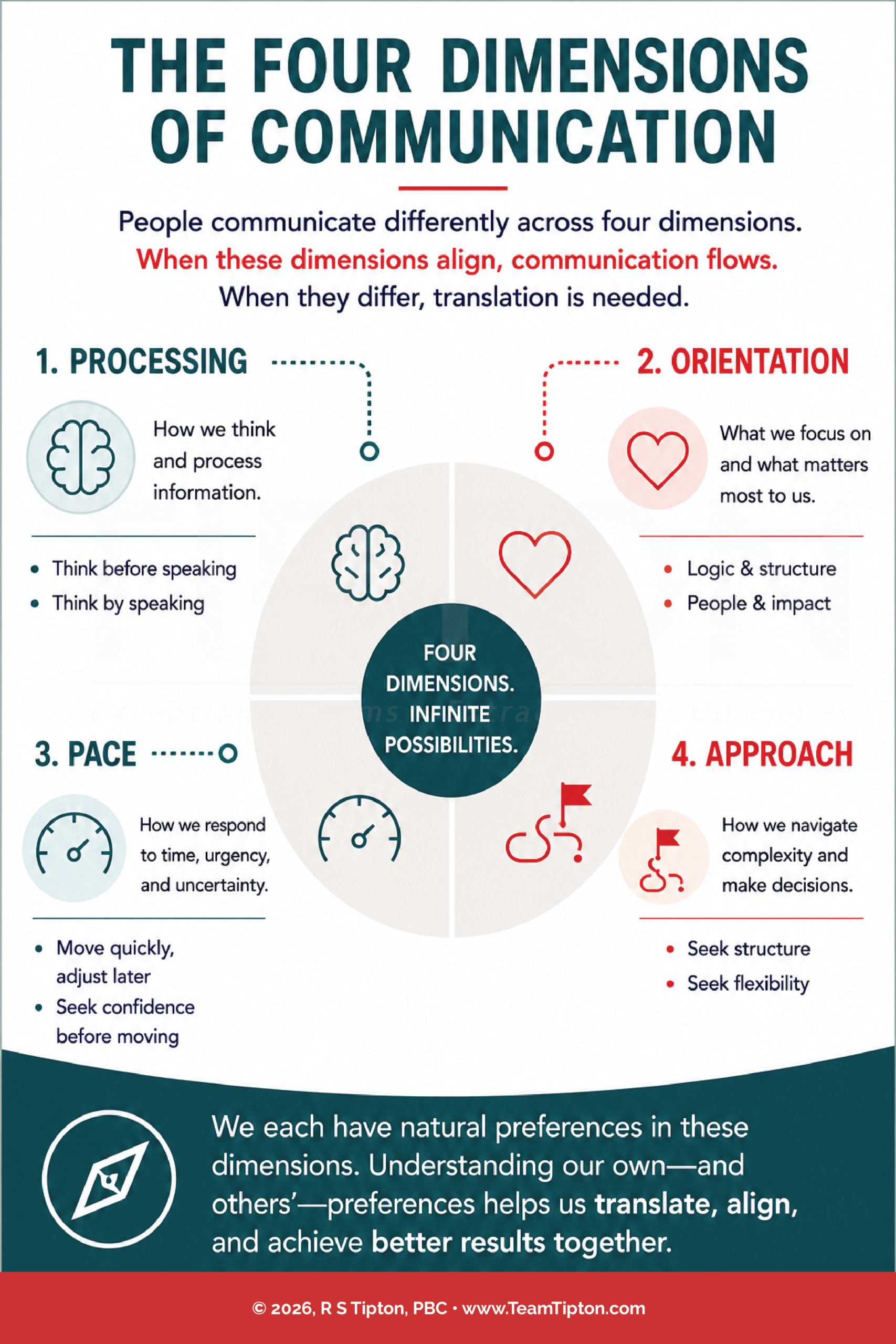
Internal vs. External Challenges
(Processing)
What’s Happening:
One person wants time to process internally, while the other processes through real-time conversation.
Common Misinterpretation:
- The internal processor may think, “They’re talking without thinking.”
- The external processor may think, “They’re disengaged or withholding.”
What Each Person Needs to Hear:
- Internal needs to hear: “You’ll have space to think.”
- External needs to hear: “We can talk this through.”
Leadership Move:
Let’s take a minute to think, then talk it through together.
Risk If Unmanaged:
The conversation may feel either rushed and noisy or stalled and disconnected.
Likely TRUE for your pair
Logical vs. Emotional Challenges
(Orientation)
What’s Happening:
One person is organizing the situation around facts and structure, while the other is organizing it around meaning, people, and impact.
Common Misinterpretation:
- The logical person may think, “They’re being too subjective.”
- The emotional person may think, “They don’t care about people.”
What Each Person Needs to Hear:
- Logical needs to hear: “Here’s the reasoning.”
- Emotional needs to hear: “Here’s why this matters to people.”
Leadership Move:
Let’s look at both the data and the impact.
Risk If Unmanaged:
Technically sound decisions may fail to gain trust, or emotionally supported decisions may lack structure.
Likely TRUE for your pair
Speed vs. Certainty Challenges
(Pace)
What’s Happening:
One person is oriented toward momentum, while the other is seeking confidence before moving forward.
Common Misinterpretation:
- The speed-oriented person may think, “They’re slowing us down.”
- The certainty-oriented person may think, “They’re being careless.”
What Each Person Needs to Hear:
- Speed needs to hear: “We can move forward.”
- Certainty needs to hear: “Here’s why this is safe enough to act on.”
Leadership Move:
What do we need to move forward with confidence?
Risk If Unmanaged:
Stalled progress, rushed decisions, rework, or avoidable risk exposure.
Likely TRUE for your pair
Structure vs. Flexibility Challenges
(Approach)
What’s Happening:
One person is seeking clarity, process, and consistency, while the other is seeking adaptability and room to adjust.
Common Misinterpretation:
- The structure-oriented person may think, “They’re inconsistent.”
- The flexibility-oriented person may think, “They’re rigid.”
What Each Person Needs to Hear:
- Structure needs to hear: “There is a clear framework.”
- Flexibility needs to hear: “There is room to adapt.”
Leadership Move:
Let’s define the structure — and where we can flex.
Risk If Unmanaged:
The team may become either too rigid to adapt or too flexible to execute consistently.
Next Steps = Learn More and Apply Your Results

Learn About Your Communications Style
AND RECEIVE A 15-PAGE PERSONALIZED WORKBOOK
(For Each Person):
Benefits: Amplify Your Strengths to Communicate with Clarity.
- Strengthen Your Impact: Learn practical strategies to communicate with clarity, confidence, and empathy across diverse settings.
- Grow with Intention: Build daily habits and long-term goals that turn your communication tendencies into leadership superpowers.
Table of Contents:
- Background Related to the Communication Style Diagnostic and an Introduction to All 16 Communication Styles
- Personalized Results — Your Graph and Specifics for What It Means to be an Adaptive Connector
- 3 Overarching Steps to Move Forward in Strengthening Your Impact
- Exploring and Setting Time-Boxed Goals
- Strategies To Communicate with Other Styles
- Intentional Daily Activities
- Tracking Outcomes
- Journaling


2-Person Composite Report
(co-workers, partners, spouses):
Benefits: Bridge Different Minds to Power-Up Understanding.
- Understand Each Other’s Core Strengths: e.g., explore how precision and depth might complement adaptability and emotional intelligence.
- Spot Natural Tension Points: Identify where different pacing, decision styles, or communication preferences may lead to friction — and how to navigate them skillfully.
- Activate Synergy: Learn tailored strategies to align logic with flexibility, turning two distinct communication styles into a high-functioning partnership.
Table of Contents:
- Background Related to the Communication Style Diagnostic and an Introduction to All 16 Communication Styles
- Personalized Graphs for Both Individuals
- Composite Analysis for the 2-Person Team: (strengths, challenges, opportunities, suggested composite communication style)
- Details for All Three Communication Styles: (One for each person and one for the composite of both individuals)


Fully Customized Team Composite Report
(for teams up to 12 individuals):
Same benefits and table of contents as #2 above but for entire teams.
- Executive leadership teams, management teams, project teams, boards of directors, city/county councils, etc.

WORKSHOP: The Art of Five-Star Communications
(for anyone):
Online or In-Person Workshops and/or Courseware.
“The Art of Five-Star Communications” is a comprehensive learning experience related to effective communications. By participating, you will learn concrete insights and tools related to all 16 communications styles (e.g., rule checkers, rational architects, balanced strategists, etc.) and how you can become more effective in your communications with them.
Learning Objectives:
- Make messages resonate, stick, and mobilize action.
- Balance clarity and empathy — learn how to adapt your message for different audiences without diluting your intent.
- Effective listening is the foundation of exceptional communication — learn proven approaches related to how to be a better listener, both actively and visibly.
- Learn how to incorporate practical techniques to avoid common leadership communication pitfalls like ambiguity, over-complication, or unintentional misalignment.
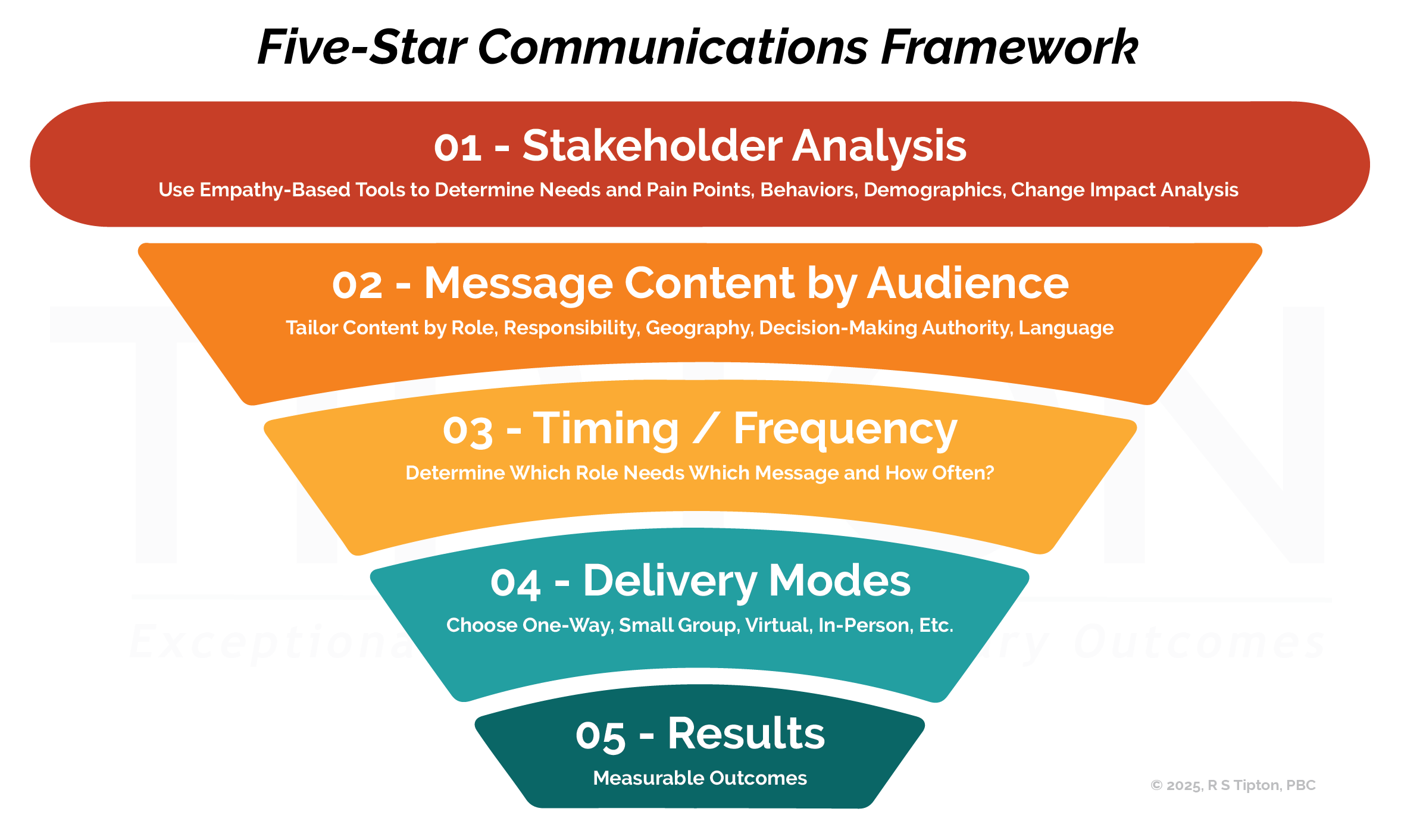


Part of Team Tipton’s Professional Development Toolkit.
This content is provided for informational and educational purposes only and is not intended to serve as professional, legal, or employment advice. The Communication Diagnostic framework and all related content are the intellectual property of R S Tipton, PBC. Unauthorized reproduction, distribution, or use of this material without prior written permission is prohibited.